 Surprise me
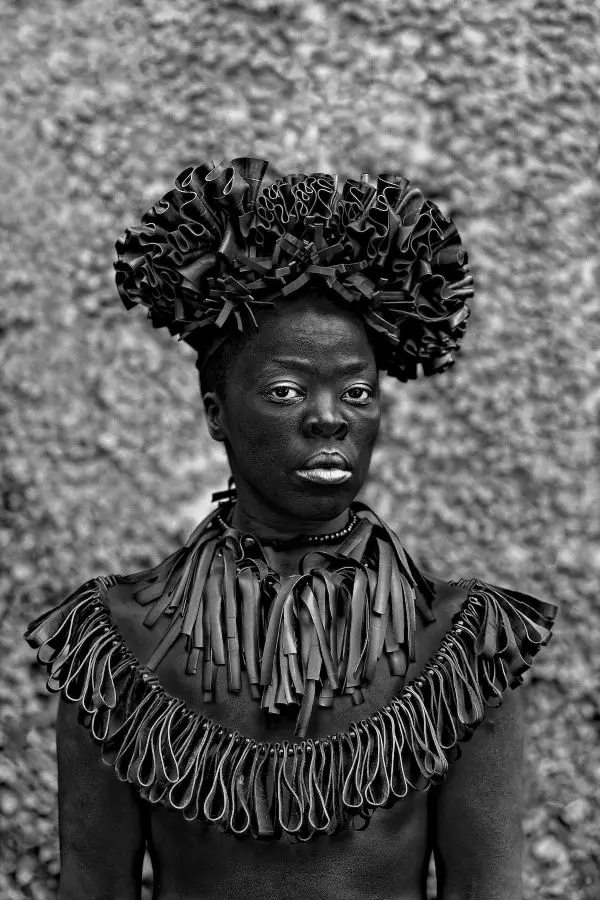
In her first solo exhibition in London, South African visual activist photographer
Zanele Muholi (b. 1972) presents her ongoing self-portrait series Somnyama Ngonyama. In more than 60 photographs Muholi uses her body as a canvas to confront the politics of race and representation in the visual archive.
Taken primarily in Europe, North America and Africa, each portrait asks critical questions about social justice, human rights and contested representations of the black body. Muholi’s psychologically-charged portraits are unapologetic in their directness as she explores different archetypes and personae and offers personal reflections.
Everyday objects are transformed into dramatic and historically loaded props, merging the political with the aesthetic. Scouring pads and latex gloves address themes of domestic servitude, while alluding to sexual politics and the suffocating prisms of gendered identity. Rubber tyres, safety pins and protective goggles invoke forms of social brutality and exploitation, often commenting on events in South Africa’s history; materials such as plastic draw attention to environmental issues and global waste. Accessories like cowrie shells and beaded fly whisks highlight Western fascinations with clichéd, exoticised representations of African cultures.
Somnyama Ngonyama playfully employs the conventions of classical painting, fashion photography and the familiar tropes of ethnographic imagery to rearticulate contemporary identity politics. By increasing the contrast in the dark complexion of her skin, Muholi interrogates complex representations of beauty and desire. Gazing defiantly at the camera, Muholi challenges the viewer’s perceptions while firmly asserting her cultural identity on her own terms: black, female, queer, African.
‘I’m reclaiming my blackness, which I feel is continuously performed by the privileged other. My reality is that I do not mimic being black; it is my skin, and the experience of being black is deeply entrenched in me. Just like our ancestors, we live as black people 365 days a year, and we should speak without fear.’ – Zanele Muholi
‘Somnyama Ngonyama presents a compelling mosaic of identities, an exquisite empire of selves. Inviting us into a multi-layered conversation, each photograph in the series, each visual inscription, each confrontational narrative depicts a self in dialogue with countless others: implicitly gendered, culturally complex and historically grounded black bodies.’ – Renée Mussai, Exhibition Curator
A majority of works in the exhibition are from Muholi’s current series Somnyama Ngonyama and are taken between 2014 and 2017. The isiZulu title translates into English as Hail, the Dark Lioness.
NEW PORTRAIT COMMISSION
The exhibition and new commission highlight the 1956 Women’s March on Pretoria. A pivotal moment in South Africa’s history, thousands of women from different cultural backgrounds united to demonstrate defiantly against repressive Apartheid pass laws, which severely restricted their movements.
Autograph ABP has commissioned four new self-portraits by Zanele Muholi for the exhibition to commemorate the struggle for equality, freedom of movement and women’s rights in South Africa and beyond.
A series of three portraits is taken at the Old Fort Prison complex at Constitution Hill in Johannesburg, where many women were incarcerated for transgressing South Africa’s pass laws during the Apartheid regime. In the fourth work Muholi is portrayed in Kyoto, Japan, exploring the poetics of identity, transgression and exile in the context of cultural traditions and locations.
These new works will be exhibited for the first time in Somnyama Ngonyama at Autograph ABP. Limited edition prints of three of the commission portraits will be available to purchase, and all proceeds support Autograph ABP’s artistic and educational programme as a charity.
Artists named in this listing
- Zanele Muholi
Were you there?
If you went, showed work or poured the wine, leave a memory or a photo and we will add it to this page.
 Tube: North Greenwich Station (1 min walk)
 Train: East India (80 min walk)